Показаны сообщения с ярлыком language school. Показать все сообщения

вторник, 16 октября 2018 г.

Have you heard that there are about 4500 cultural heritage sights on the territory of Karelia?

Enjoy Russian student from Luxembourg Eleanor came to Karelia about 3 weeks ago. She successfully combines learning Russian in Petrozavodsk and discovering new places all over Karelia (the Republic in the Russian North-West). A few days ago Eleanor and a group of students came to the most outstanding sight - Kizhi museum which is located in 50-min water-ride from Petrozavodsk. 


“I’m eternally grateful to the school for organizing the whole thing for me, which meant that I got a tour of the island with a group of Russians, led by the very lovely Evgeniya.” What are the secrets of traditional nineteenth-century constructions? How do the craftspeople live on the island full time? Let us give the floor to Eleanor.

_______________________________________________________________

READ THE WHOLE ARTICLE by Eleanor and think about coming to Petrozavodsk to open up Russia and its culture! Choose a course HERE

понедельник, 23 июля 2018 г.

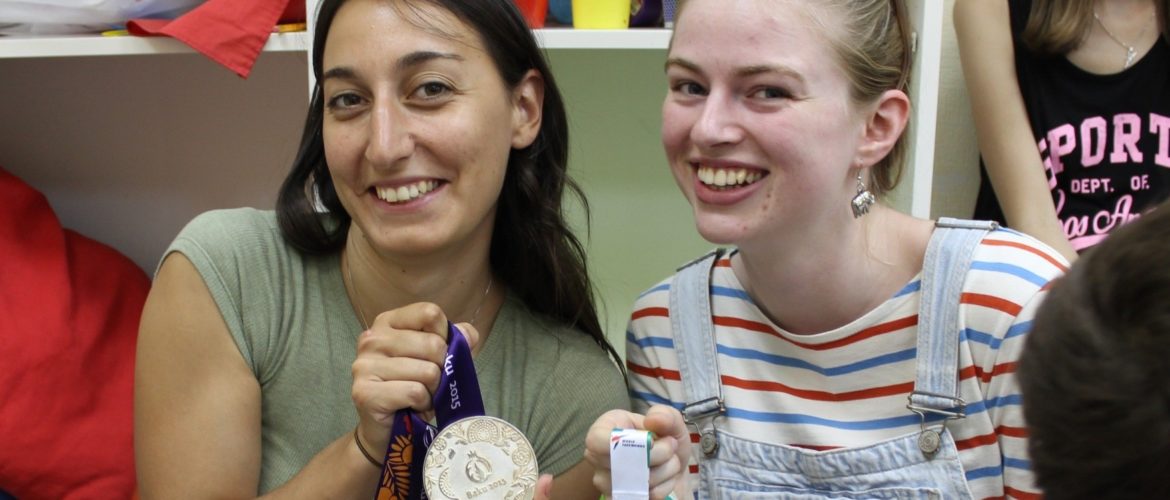
Volunteers from Great Britain, Italy and Denmark teach children not only English

Why do we invite Enjoy Russian students to volunteer in the language camps? Because this is a two-way collaboration: guys learn the language (Russian) and teach the language (English) which turns out to be very efficient. This is the opportunity to come to a better understanding of how to speak a foreign language.

We usually ask the participants of the International Camp "What did the volunteer teach you?"
That's what they say:

- I learned so much about London and the way of life in England! And I also learned a lot of useful phrases
- The volunteer taught me to write in Chinese.
- Julia always cheered us, she is so funny!
- The volunteer helped me to learn about the countries, told about the Leaning Tower of Pisa
- The volunteer taught me how to work in a group, and also told me that Hollywood is in Los Angeles!
-  These two weeks were undoubtedly the most stunning and exciting in my whole life!


четверг, 5 июля 2018 г.

FIFA WORLD CUP: THE FACTS WHICH ARE NOT COMMONLY KNOWN


  • The FIFA World Cup is the tournament held every 4 years for men’s teams of member associations of FIFA. The 21st edition is being held this year in Russia.
  • There are two teams that have qualified for the first time- Iceland and Panama.
  • Zabivka, a wolf is the mascot for the World Cup.
  • The oracle for this world cup is Achilles who lives at the world famous Hermitage Museum in St Petersburg.
  • The official song is called “Live it up” with vocals by Will Smith, Nicky Jam and Era Istrefi.
  • This is the first World Cup VAR (video assistant referees) are being used.
  • The winners of the World Cup from 1930-1970 won the Jules Rimet Trophy (named after the FIFA President).
  • After 1970, the trophy was changed to the Fifa World Cup Trophy.
Read the whole interview with Nick - https://enjoyrussian.com/mundial2018/

вторник, 29 мая 2018 г.

7 Facts about Everyday Life in the USSR


Welcome to MATRYOSHKA’S DIARY, the weekly column about Russia, its history and people. Today our author Elena Kiliakova tells us about some amazing and even shocking facts about everyday life in the Soviet Union. If you want to know more about pioneers, Artek and unbelievably huge lines in front of the shops in the USSR just keep reading!


1. People in the Soviet Union took recycling seriously.

Back then we had no options other than to be environmentally friendly. Dairy products (such as milk, sour cream, and other traditional Russian dairy products were packed in glass bottles of different shapes and forms). We never threw them away, but reused! Another mainstream thing was a net tote bag – even though I was born one year before the USSR collapsed I still remember my grandparents using them. These days it is a must-have for those caring for the environment.


2. Did I mention that we took recycling seriously?

Back then we had special competitions – people who collected a set amount of paper (magazines, newspapers and old books) got a very special prize for reaching the goal. What was the award? Those who won the competition were granted an opportunity to purchase a book or a towel or something that was next to impossible to buy in the shops. My mum told me a story how she got a set of towels.


3.Food stamps

It is probably different to imagine it now, but back then we did get food stamps or vouchers which could be exchanged for a set amount of food/goods. Back then you could not just go to the supermarket and buy anything you like from any country you can think of. We had stamps for groceries which were allocated at work (everyone back then had a job). Everyone was given a set amount of goods (groceries)– so the stamps were used to buy some necessities. Some real numbers to get a feeling what was it was like to live in the USSR: one got food stamps that were sufficient to buy one kilo of sausages a month (among other groceries).

4. A legendary Artek camp

In the Soviet era, Artek was a landmark of the USSR. Located in Crimea, the camp was the first resort for young pioneers — the Soviet equivalent of Boy or Girl Scouts. Unlike other recreational facilities for children and youth, Artek was (and still is) open not only in summer, but all year round. The camp attracted children from the USSR (and all over the world really), and was visited by internationally recognized people, like Indira Gandhi.

 5.The 15 sisters

During the Soviet era, the 15 member states had strong ties and economic relationships. The states of the USSR were called 15 sisters. You can experience the special connection which existed back then if you visit the VDNKh or the Exhibition of achievement of the national economy in Moscow. There is a pavilion for each of the member states showcasing the best of what the member state (or I should say an ex-member) had to offer. Some of the main features include the Friendship of Nations fountain and the Cosmonauts’ alley.

6.Take me to…

We had a strong social welfare system which was funded by government. A special feature of it was resorts. Back then a concept of unemployment did not really exist – everyone wanted to work (and was given an opportunity to work) and contribute to the economy. This meant that if you were a member of a union, you could get a heavily subsidised or a free holiday package for yourself and your family members. What a luxury!

7. The Pioneer movement

The Pioneer movement was an equivalent of the Scout movement in western countries. Children and youth were accepted to the organization based on academic merit and other achievements. There were three stages depending on the age:
– Octyabryata– from year 1 to4(Primary School) – were given a pin-shaped like a star with a portrait of Lenin.
– Pioneers – from 5 to year 8(Secondary School) had distinguishable red neckties.
– Komsomoltsy– from year 8 to 10 (High School).
During the existence of the Soviet Union, thousands of camps and palaces (an alternative of a community youth centre) for members were built. These were exclusive only for Young Pioneers/Octyabryata/Komsomoltsy, which were free of charge, sponsored by the government and trade unions


Check out other posts here and follow the news! Some other facts are coming soon:)
And if you want to learn Russian and ask more info about the Soviet era, best teachers are here to teach you by Skype!

четверг, 24 мая 2018 г.

Want to sound more natural in Russian?

Then keep these 10 polite phrases somewhere close!

1. Спасибо (SPASIBA) – Thank you
2. Пожалуйста (POZHALUSTA) – Welcome / Please
3. Извините (IZVINITIE) / простите (PROSTITIE) – Excuse me / I’m sorry
4. Ничего (NICHEVO) – That’s OK (That’s NOTHING)
5. Будьте добры (BUD’TIE DOBRY) – Would you be so kind
6. Извините, можно (мне)…? (IZVINITIE, MOZHNA MNIE) – Excuse me, can (I) have…
7. Извините, вы мне не поможете? (IZVINITIE, VY MNIE NIE POMOZHETIE) – Excuse me, could you help me?
8. Не могли бы вы мне помочь / показать… / дать… / принести… (NIE MOGLI BY VY MNIE POMOCH / POKAZAT’ / DAT’ / PRINIESTI) – Could you help me / show me… / give me… / bring me…
9. Дайте, пожалуйста, … (DAITIE POZHALUSTA) – Give me, please
10. Покажите, пожалуйста, … (POKAZHITIE POZHALUSTA) – Show me, please
📚Want to learn more? Choose individual Russian course at #EnjoyRussianSchool with a professional tutor! Take 80 lessons and pay €17 per lesson!
📚Or learn Russian by Skype for only €15 per lesson - http://online.enjoyrussian.com/


среда, 11 апреля 2018 г.

WANT TO PASS FOR RUSSIAN? EAT FISH!


Kalakunda: traditional Fish holiday in Karelia

We all know that tastes differ. Dutch people are crazy about stroopwafels, French can’t imagine themselves without camembert and Russians are believed to eat caviar daily. But actually, here in the North-West of Russia we love fish more than caviar! As you know Enjoy Russian School is situated in the land of lakes and the “fish tradition” of Karelian people goes back to the settlement times when people had to take the advantages of generous Mother Nature. In August 2018 Russians living in Karelia will celebrate the Fish holiday KALAKUNDA. What does it mean and how do we celebrate it?

Traditional Russian activities to enjoy the fish fest

Karelia is well known for its fishery. First and foremost Kalakunda holiday is a fishermen competition. About 150 professionals compete in trout hooking on the river Lososynka. Last year winner has caught 2 trout with the total weight of 3 kg (approximately 6.6 pounds).
The holiday program offers a variety of activities for adults and children. Of course, everything is connected with fish – you can buy fish, can make souvenirs from fish, cook the traditional pie, enjoy the performances in which fish is the ultimate superhero. But one of the most important things is that you may listen to the ancient tales and sagas about Karelian heroes.
What else can you do here?
  • Take a picture of the reindeer
  • learn traditional Karelian dance;
  • play outdoor games;
  • take part in the workshops and learn how to make woodenware and furniture, fish bones jewelry!

One fish-idiom to sound like a Russian

One of the most common idioms in Russia is connected with the fish: как рыба в воде (kak ryba v vad’e)
Literal translation – like a fish in water. It means to feel comfortable somewhere.
Example:  Хотя он приехал в школу Enjoy Russian всего две недели назад, он чувствовал себя как рыба в воде. (Even though he came to Enjoy Russian school just two weeks ago he felt very comfortable)

Want to feel the taste of Russia? Come to Enjoy Russian school to experience full Russian immersion! Choose a course here

среда, 4 апреля 2018 г.

STAY ACTIVE AND RUN FOR YOUR LIFE!

\

“Karjala Marathon” is to take place in the north-west of Russia

Russians interest in healthy lifestyle and sport events is growing year by year. If you believe in physical power of your body more than in your car when it comes to traveling come to Russia and run for your life! “Karjala Marathon” is calimed to be one of the most colorful race in the whole North-West of Russia. The annual event brings together kids and adults from Karelia and other Russian regions and cities – Moscow, St. Petersburg, Novgorod, Archangelsk and Murmansk. Lerning Russian language in autumn 2018 is a great opportunity to see by yourself that sport and health do not have any boundaries and language barriers!

Russian “Lagom”: is 10 km just enough?

As for the details: the route (both adults) is 10 km long. Pretty harsh, isn’t it? But professional sportsmen say one should not get into panic and just choose an even pace throughout the whole  run-session.  As for the main advantage of the route  it is incredibly picturesque as it lies right by the lake Pryazhinskoe (about 60 km from the capital of Karelia). Stony lake side, tall pines and amazing views give you  extra strenght on your way and make you feel nature’s energy. But stay focused on the race, with this beauty it’s very easy to find yourself “beating around the bush”:)

Eat kalitki and get carried away by Russian tradional rhytms!

Right after the race do not leave immediately because the cultural program of the festival is definitely worth checking out. Musical and national folklore bands, cooking workshops and traditional games competitons will show Karelian history of 2, 3 and 4 generations!
Participants say: “The race was the final point of our vacation in Karelia. The organizers arranged a real national holiday on this day! We were extremely hapy to see the medals from shungite (rare mineral which can be found only in Karelia) were waiting for us at the finish point. During the race fans were entertained by creative bamds  and even Karelian Santa Claus! No one felt bored!”
“An excellent opportunity to relax, to be surprised, to gain new impressions, to visit Karelia! A stunning level of organization and excellent weather caused a storm of positive emotions from participating in the Karelian Running Festival!”

If you feel like trying something new this autumn do not hesitate and come to learn Russian at Enjoy Russian school and stay healthy&active! Choose a course here

четверг, 22 марта 2018 г.

THE MOST TASTY RUSSIAN LANGUAGE LEARNING MATERIALS!


How to serve Russian dumplings and cook raspberry buns?

Welcome to Enjoy Russian language school blog! One of the categories here is devoted to learning materials for you to simplify your Russian language exciting journey. But today’s post is a bit special. It’s not only about Russian grammar and the way Russians live. It’s about diverse and unique Russian cuisine. Some say it’s a mix of different cultures’ cooking traditions – Eastern European, Caucasian, Central Asian, Siberian, and East Asia. So grab a snack not to get hungry and make your recipe  book ready to Russian Cyrillic alphabet! Let’s go!

How to cook and serve Russian food?

What do Russians miss when they live abroad? The whole variety of products! ? Listen to the most tasty Russian podcast to find out!
1:58 – Bliny – what to serve with?
3:45 – Cottage cheese: rich in calcium
4:40 – Pelmeni or Russian dumplings – the origin
6:50 – Vareniki – sweet or salted?
8:00 – Pirog – big layered Russian pie
8:45 – Russian soups – borsch and okroshka
12:10 – Vinegret
13:20 – Meet jelly
14:00 – Russian traditional drinks
https://soundcloud.com/enjoyrussianschool/what-flavor-does-russia-have-russian-cuisine

Russian raspberry buns recipe

For those who wants not only learn something about Russian food but also to put knowledge into practice we suggest baking delicious and easy-to-cook Russian raspberry buns
  • Put 1/4 cup of warm milk in a small bowl. Add 1 teaspoon flour and 1,5 teaspoon sugar and stir to dissolve. Let it stand about 5 minutes.
  • Mix 1 cup of flour and 1/4 cup warm milk in a bowl. Pour in the yeast mixture and mix it. Cover the bowl with a towel. Let the dough rise in a warm place (for about two hours)
  • Mix butter, 1 egg yolk and 2 tablespoons of sugar about 3 minutes. Add it to the dough; add in 1 cup flour and 1/2 teaspoon salt.
  • Preheat oven to 175 degrees C
  • Cut the dough into 8 pieces and make 8 balls.
  • Press down the center of each bun and fill the hollows with raspberry jam.
  • Bake in the oven for 25 minutes.
  • Enjoy!


Follow our news and see you soon in Russia! Choose a course here

воскресенье, 18 марта 2018 г.

Top 10 Russian  Presidential Elections phrases

You can hear it everywhere in Russia on 18th of March

Today is a very important day in Russia. Yes, we do not talk about politics here in our blog since it is devoted mostly to Russian language, interesting facts about Russia and its people. But it is really impossible to stay indifferent to Russian presidential election we have today. So here is Enjoy Russian School representation of this day – top 10 most common Russian words and phrases of 18 of March! Read and learn or maybe roleplay  Russian elections wherever you are right now:)


  1. Выборы - vybory - The elections
  2. Голосовать за - golosovat' za - to vote for
  3. Бюллетень - Byulleten' - a ballot
  4. Президент – Prezident - President
  5. Избирательный участок –  Izbiratel'nyy uchastok - electoral district
  6. Абсолютное большинство – Absolyutnoye bol'shinstvo - vast majority
  7. Политическая партия – Politicheskaya partiya - political party
  8. Избиратель - Izbiratel' - voter
  9. Явка избирателей – Yavka izbirateley - voting turnout
  10. Итоги голосования – Itogi golosovaniya - voting results
Follow the news to learn Russian with us or come to our school to practice in real life situations!
Choose a course here 

пятница, 16 марта 2018 г.

DON’T GO BACK HOME IF YOU FORGOT SOMETHING!


Russians are really superstitious, they believe in lots of different signs, and omens. Today, we’ll tell you one.

Why you shouldn’t turn back if you are halfway there

All Russians know since childhood that if on your way somewhere you realize that you’ve forgotten something at home, you shouldn’t go back. If you do, bad things will happen.

What’s the origin of this superstition?

Since long ago, crossing a threshold of a house was considered a sacred act, because people used to bury their ancestors’ ashes under the threshold of their house. When a person crosses the border between his home, and “strange”, not a home space, he/she is looses protection of his ancestors’ spirits. Also a threshold is a border between world, a doorway through some evil spirits might come into our world.
The spirits might get angry if you cross the threshold without fulfilling your plans. If so, they will confuse all your thoughts, and interfere negatively in the upcoming affairs. In addition, the guardian angel after returning can stay at home and not go with you on a second journey.

What to do?

Many people believe that it is possible to neutralize the effect of the omen if you look in a mirror or sit for a while, when you return home. They say that when you leave the house you are always “blessed” by a brownie (house spirit), and he does it only if you sit down before leaving. As for the mirror, looking at it, you “reflect” the evil spirits standing behind you, and at the same time multiplying your strength and energy.
But speaking the truth, not so many people believe in this omen, because is you forget something it only means that you are absent-minded:)
Learn Russian language and culture in Petrozavodsk! Enroll for a language course here

среда, 14 марта 2018 г.

RUSSIAN GRAVITY FALLS


Vottovaara mountain in Karelia 

On September 3 Enjoy Russian language school starts a group course for people who wants to start speaking Russian in a short time (you may enroll here). We usually offer diverse cultural program to our students but sometimes they choose the places to visit in Karelia by themselves and this autumn we highly recommend you checking out some mystic places in Russian North. Why? Because here in Karelia we have it all: mountain idols, ancient petroglyphs, stone labyrinths and one more place – Vottovaara mountain. It can be compared to Gravity Falls  from the famous Disney series and here’s why.

A healthy habit to explore: what is Vottovaara mountain famous for?

They say one may find mystic spots almost in every Russian region. Near Chelyabinsk, lake Baikal,  Chukotka or even in Moscow (famous Patricarch’s  Ponds described by M. Bulgakov in his novel). The Republic of Karelia is not an exсeption.
People say Russian North is a place of energy and inner strength and that a trip around all the “unordinary” spots in Karelia may take 1 month. Vottovaara mountain (470 m) is a place that the locals are always asked about. The mountain was discovered about 30 years ago and still catches everyone’s attention. It is situated in the Central Karelia not  far from Segozero lake. Some ppeople are ready to take travelers there while others strictly say NO. Let us clarify what’s wrong with this place and why everyone should see this.
  1. You may fall asleep in a second. That happened many times with travelers. May be because of ancient Saami people’s rituals or because of the placebo effect. Anyways, you should come to try.
  2. Stones are everywhere. Almost 1500 stones that are called “seidy”. They look like absolutely typical stoenes but there is one tiny moment here. They are extremely heavy but when you get closer to one of them you notice that it stands on several stones that are extremely small in comparison with this big one. How did they get under? No one knows.
  3. Spectacular view of the whole Karelia and even Finland. Even though it is not that high, you may see beautiful lakes and forests of Karelia and even a part of neighbouring country.
  4. Go here if you are a UFO hunter. The locals say you may see here aliens from time to time.
  5. The most tranquil place in Karelia and maybe in the Russian North. Not a single bird, fly or ant. Just you and the energy of mysterious Karelia.

четверг, 8 марта 2018 г.

IF YOU LOVE RAIN, GO TO PETROZAVODSK. IF YOU DO NOT, ALSO GO! WHY?


Why to choose Petrozavodsk to study Russian in Russia?

If Moscow and Saint Petersburg are the only cities you remember when talk about Russia, it is time to find a new direction! Visit Petrozavodsk! It is small and cozy city, good for life, rest and study Russian! Students of the “EnjoyRussian” Language School tell you why to come to Petrozavodsk to study Russian in Russia and have amazing vacation in Summer 2018. So why?

Improve Russian skills

Because there is a brilliant language-school in this town. In daily lessons of four hours, we – a group of Swiss students from Basel – improved our Russian-skills. We were not just teached in grammar. We also watched funny “multfilms”, read texts and discussed about Russia und Switzerland. But the lessons are just one argument, why you should go to Petrozavodsk.

Make Russian friends

The other argument for a stay: the school’s volunteers. They do everything, to make their foreign students happy. They organise national-food-parties, lovely days at the beach (beautiful weather inclusive), trips to Kizhy-Island, to St. Petersburg or to a banja. They also help you to find the next disco or internet-café, they give you any assistance at the railway station you need – while queuing up for hours or while buying your ticket to everywhere. The volunteers are the most important argument, why you should join Petrozavodsk for your study in Russia.

Feel Russian hospitality at its best

But there is another one: the guest-families. They do everything to make you feel like a little Tsar and to improve your Russian. They even invite you to their Datshas. Russian hospitality at its best. That is what is important, that is how you learn about country and language.
Well then, who cares about a few raindrops?

понедельник, 5 марта 2018 г.

DIDN’T EXPECT TO FALL IN LOVE WITH A RUSSIAN GIRL


A student from Germany came to Petrozavodsk to learn Russian and found the love of a lifetime

Many things happened at Enjoy Russian school since 2003. All the students come here with the main aim – to start speaking Russian and try to live like a Russian for a while. But sometimes incredible things may take place and students find not only good Russian friends or meet a perfect host family. They find love of a lifetime. That is what happened with Andreas from Germany in 2014. Here is a story of his wife, amazing Irina who moved from Russian city of Petrozavodsk (where Enjoy Russian school is situated) to Germany.

Russian love story: he chose Petrozavodsk out of almost 1000 Russian cities

“Hello, everyone and happy 15 birthday, dear “Enjoy Russian”! You have a very special place in my heart and here is the reason why… 🙂 
At Uni I’ve studied international relations and in september 2014 we had practice weeks during which i’ve worked at a language school called… “Enjoy Russian”:) One day our lovely boss asked if somebody could dedicate couple of hours and do a small city tour for russian language students. Introverted part of me hesitated for a second, but rational one was saying: “It can be fun, why not?!”. And indeed it was:) 
Shall I say that among those students was a lovely man who stole my heart?) At such moments you can’t help but believe in fate… Exactly that autumn he decided to go to Russia, he chose Petrozavodsk out of almost 1000 Russian cities, he chose the school where i’ve happen to have my internship… right time, right place, what a chance?:)
Since then my life has drastically changed: I graduated from University, married my best friend, moved countries to be with him and now we are growing our little precious baby!”
We are always extremely happy to know something about our students life, especially when they share that nice memories and such a great news! Wish you guys all the best and hope that your daughter will come to learn Russian in Petrozavodsk one day too!


Choose a course and join us! And who knows what can happen to you in Russia!

пятница, 23 февраля 2018 г.

GREAT LENT BEGAN in russia! WHAT SHOULD WE EAT NOW?


The brightest, funniest and most entertaining of Russians holidays Maslenitsa has just finished. Yesterday a 49-day Great Lent began.

Great Lent, or the Great Fast in Russia

ВЕЛИКИЙ ПОСТ (Great Lent in Russian) is the most important fasting season in the church year in Russia, which prepares Christians for the greatest feast of the church year, ПАСХА (Easter).
In many ways Great Lent is similar to Lent in Western Christianity. There are some differences in the timing of Lent (besides calculating the date of Easter) and how it is practiced, both liturgically in the public worship of the church and individually. Observance of Great Lent is characterized by fasting and abstinence from certain foods, intensified private and public prayer, self-examination, confession, personal improvement, etc. In this post we will tell you what Russians eat during the Great Fast.
During the lent only lenten fare is permitted by the Russian Orthodox Church. At this time old Russian proverb “ЩИ ДА КАША – ПИЩА НАША” (shchi da kasha – pischa nasha) (cabbage soup to porridge – that’s our food) makes much sense. Of course, not all Russian people fast – only deeply religious ones. But during the Great Fast many restaurants serve lenten food.
Among prohibited products there are meat, milk, eggs. Fish is allowed on special days. There are food calendars that inform about which food is allowed to eat on which day.

The most popular Russian lenten dishes

During the Great Fast people usually eat potatoes, noodles, bread, different porridges, fruits, and vegetables. There are some traditional Russian dishes that are very popular during the lent.

Vinegret


It’s a Russian traditional vegetarian salad, made of beets, potatoes, sauerkraut, peas, pickles… Ingredients might slightly vary per household and restaurant.

Vareniki


It’s Russian and Ukrainian classic pierogi, loaded with cheesy potatoes and an easy melt in your mouth homemade dough! There lots of types of vareniki: with potatoes, with potatoes and mushrooms, with cherry, with cabbage… If you make the dough without eggs, vareniki will be a perfect lenten dish!

Pickled vegetables


It’s not easy to find really good fresh vegetables in this time of the year in Russia, so pickled ones are the best substitution
Do you want to try traditional lenten food? Come to Petrozavodsk, experience Russian culture, and learn the language at our Russian courses. Enroll here

среда, 21 февраля 2018 г.

THE LEGENDS OF THE NORTH


Go berserk and enjoy ancient sagas at Medieval times International Festival in Karelia!

Telling the truth not every student who comes to learn Russian language in the North of Russia lives with the host families. Of course Russian homestay is the best option however sometimes the call of the wild breaks down the system of “everything is on the right track”. The historical Campus on the shore of Onego lake (the 2d biggest lake in Europe by the way) is going to be established in August 2018. For those who seek some unique places to visit in Russia and some authentic activities to try the “Legends of the North Festival” is the first must-see-item!

Learn how to set a fire both to your Russian trip and on the ground

We’d already written the post about Karelia and North-West of Russia as a place where many legends were born. Golden Mermaids, stones  “seidy” and Karelian Nessy, stories about brave men who conquered the death and forest creatures helping travelers to find a way.  They say Karelia is a land for spiritually strong Russian men. According to the legend Karelian people ancestors came from the North and to survive in these harsh weather conditions they should have been pure in heart and strong in spirit.
“Legends of the North” Festival proves all mentioned above and is slowly becoming the event people associate Karelia with. On 5th of  August citizens are invited to be fully immersed by the authentic Nordic atmosphere of 9-11 centuries, try on some elements of clothes, armor and weapons, get acquainted with historical handicrafts and take part in numerous unique workshops and talk sessions:
  • Moulded ceramics workshop
  • Scandinavian poetry of scalds
  • Elementary leather goods. Types of hides and skins. Their destination. Where to search for materials.
  • the Swedish overtone flute making class
  • archery and throwing knives workshops

The best place in Russia for those who’re attracted by the North

Not only the sounds of folk bands performance might be heard here but also metallic clang from everywhere! So the bravest ones may take a sword and become the best in the battle.
“That was the greatest show! The level of organizing was really high, we could take pictures with the warriors, fight with swords, watch and photograph handicrafts and life, learn something new and communicate with people who can’t imagine their life without the Legends of the North!” (says one of the participants in 2017)
Don’t you think it’s your turn to try this? Choose a course and come to Karelia!

понедельник, 5 февраля 2018 г.

HOW TO LEARN THE RUSSIAN ALPHABET QUICKLY


Do you want to learn Russian? Start with the alphabet!

The Russian alphabet is based on Cyrillic script the same as some other European languages (Bulgarian, Belarusion, Serbian, and etc.). It consists of 33 letters: 10 vowels, 21 consonants, and 2 signs (hard and soft).

To make learning Russian an easy thing you can follow these tips:

1. Memorise the letters in groups
  • Group 1. Letters that are written and pronounced the same as English ones:
А, О, К, М, Т
Russian “A” must be pronounced as “a” in “car” or “u” in “cut”. Not as “a” in “man” – that would be wrong.
Other letters are pronounced exactly the same as in English.
  • Group 2. Letters that exist in English, but are pronounced differently (used for a different sound than in English):
В = V like in “vodka”
Е = YE like in “yeah”
Н = N like in “nose”
Р = R !Rolling R! It doesn’t sound the same as English “R”! You should place the tip of your tongue right after the upper teeth, breathe out to push it with air until it starts vibrating. You need to practice regularly until your tongue muscles get strong enough to be able to produce the required vibration.
С = S like in “sun”
Х = H like in “hot dog”, though it’s stronger than the English “h” sound
У = U like in “put”, not like in “cut”!
  • Group 3. Absolutely new letters that do not exist in English: 
Б = B like in “bar”
Г = G like in “garden”
Д = D like in “dance”
Ё = YO like in “yolk”
Ж sounds like “s” in “pleasure”
З = Z like in “zoo”
И = I like in “kitten”
Й  is called a short “i” sound, and sounds like “y” in “yogurt”
Л = L like in “love”
Ф = F like in “flower”
Ц = TS like in “its”
Ч = CH like in “chess”
Ш = SH like in “shop”
Щ = SHCH / SH like in “sheep”
Ъ – hard sign, which is used to separate cyllables one from another
Ы is a bit similar to “i” in “it”, but must be pronounced further down the throat, and be more short.
Ь – soft sign, makes consonants foft
Э = E like in “vet”
Ю sonds like “u” in “pure”
Я = YA like in “yard”
2. Listen to audio recordings of Russian native speakers pronounce the letters and words with the letters, and repeat after them. Do it as much as possible. It will help you to form a good pronounciation.
3. Play games with the letters
4. Listen to funny songs and sing along!
5. Ask your Russian friends, if you make the sounds right and get 101 more tips from them about how you should learn the Russian alphabet;)

Hope you will enjoy learning the Russian language. If you want to enjoy it more, join our Russian language courses in Russia. 

пятница, 19 января 2018 г.

SURVIVAL RUSSIAN FOR TROUBLESOME SITUATIONS


Of course we are sure that your stay in Russia will be pleasant and fun, but…

if you ever get in trouble (hope not) here are some phrases that might come in handy:
ПОМОГИТЕ, ПОЖАЛУЙСТА! [POMOGITIE, POZHALUISTA] – Help, please!
Я ЗАБЛУДИЛСЯ [YA ZABLUDILSYA] I got lost
У МЕНЯ УКРАЛИ КОШЕЛЁК / ДЕНЬГИ / СУМКУ [U MENYA UKRALI KOSHELYOK / DENGI / SUMKU] My wallet / money / bag was stollen
Я ПОТЕРЯЛ МОЙ ПАСПОРТ [YA POTIERYAL MOI PASPORT]  – I lost my passport
У МЕНЯ СЛОМАЛСЯ ТЕЛЕФОН. МОЖНО ПОЗВОНИТЬ? [U MENYA SLOMALSYA TELEFON. MOZHNO POZBONIT] – My phone has broken. Can I make a phone call?
Я НЕ ПОНИМАЮ ПО-РУССКИ [YA NIE PONIMAYU PO-RUSSKI] – I don’t understand Russian

And of course something you really need to know is how to say “I can’t eat anymore”!

If you ever visit a Russian family make sure you know how to refuse from food, because otherwise you’ll be fed until you can’t move:)
Я БОЛЬШЕ НЕ МОГУ ЕСТЬ [YA BOLSHE NIE MOGU YEST] – I can’t eat anymore
СПАСИБО, Я НЕ ХОЧУ БОЛЬШЕ [SPASIBO, YA NIE HOCHU BOLSHE] – Thank you, I don’t want anymore
ХВАТИТ / ДОСТАТОЧНО – [HVATIT / DOSTATOCHNO] – Enough

Some Russian people might want to drink vodka with you. Here are some phrases how to refuse politely.


СПАСИБО, Я НЕ ПЬЮ [SPASIBO, YA NIE PIYU] – Thank you, I don’t drink (alcohol)
ТОЛЬКО ЧУТЬ-ЧУТЬ [TOLKO CHUT-CHUT] – Just a little bit
ТОЛЬКО ОДНУ РЮМКУ [TOLKO ODNU RYUMKU] – Just one shot
БОЛЬШЕ НЕ НАДО [BOLSHE NIE NADO] – No more!